Posts

Budget 2020 - Personal Taxes

A lot of changes have been proposed to personal income taxes in the recent budget. This blog aims to capture most tax changes impacting the common man.. Changes to Personal Income Tax Assessees can now opt for a new simplified tax regime if they forego all current exemptions (mainly salaried class) such as LTA, HRA & 80C deductions. It also includes foregoing set-off of losses from house property against salary income. 1. 5% tax for income between Rs 2.5 and Rs 5 lakh 2. 10% tax for income between Rs 5 and Rs 7.5 lakh 3. 15% tax for income between 7.5 lakh and 10 lakh 4. 20% tax for income between 10 lakh and 12.5 lakh 5. 25% tax for income between 12.5 lakh and 15 lakh 6. 30% tax for income above 15 lakh Criteria for Non-Resident Indian (NRI) status A person who stays more than 240 days abroad is considered a NRI and can enjoy the respective tax reliefs available. Anyone staying less than 240 days abroad in a financial year is considered as a TAX RESIDENT of India and would be...
Budget(s) 2019

Interim budget 2019 was presented in Feb'19 and final budget post election was presented on 5 July 2019 by India's first woman Finance Minister and Tamil nadu's very own Smt.Nirmala Sitharaman. This blog attempts to capture the budget updates relevant to personal taxation. Key Highlights from both budgets Some of the key highlights on personal taxation for FY2019-20/AY2020-21 include: PAN & Aadhar are now interchangeable, allowing one to use Aadhar to file her/his income tax returns. Cash withdrawal in excess of Rs.1 crore will attract TDS of 2% (Tax Deduction at Source) ONE NATION ONE CARD - based on RuPAY to be introduced / used across bus travel, tolls, parking & retail across the country. Tax on Total Income For assessees with income in the range of Rs.2.5L to Rs.5L p.a, complete tax rebate is offered u/s 87A. This means zero tax for income upto Rs.5L. However, assessee must file Income Tax returns if income exceeds Rs.2.5L to claim this rebate. Not...

Who's winning when Nifty is @12k?

Today nifty mounted 12000+ but what did that do to individual portfolios and wealth? Who's actually winning? This blog examines these questions in the light of domestic savings and shift in investment patterns! Domestic Savings Domestic savings in India comprises of 3 sectors - households, Private & Public sectors. Households make up the largest pie, making 60% of total domestic savings. Most of the household savings are stored in 2 forms - physical assets (home/land/gold) and financial assets (bank deposits, bonds, stocks & mutual funds). India's savings rate as a % of GDP has declined from 36% (2009) to 30% (2019). Between 2009 & 2019, in particular, households savings rate as a proportion of GDP (Gross Domestic Product) declined from 25.2% to 17%. While inflation was high at 9-11% between 2009-13, it was subsequently brought down by RBI's inflation-targeted monetary policy to sub-4% in 2019. This means, real interest rates (nominal rate minus inflation)...

Is this India's Sub-prime moment?

Ever since the IL&FS crisis hit the Indian markets in Sep'18, several things have changed for the NBFCs (Non-Banking Finance Companies), Banks and investors in debt mutual funds. This blog looks at the core problem and resulting implications for retail investors! Background NBFCs are non-deposit taking organizations that are known to reach channels not easily accessible by banks for lending. NBFCs primarily takes loans from banks and instituitional investors such as Mutual Funds & Insurance companies at say 10% and lends it to businesses such as MSMEs, Real estate builders etc at say 14%. They make 4% (14% - 10%) of the entire loan disbursed, provided such loan gets repaid. Similar to banks, unpaid loans get classified as NPAs (Non-Performing Asset). NBFCs must also set aside money from their profits to cater to such NPAs (called Provisioning). The Stats Per RBI, as of Mar'18, total bank deposits in the country stood at Rs.117Tn (Lac crores), with NPAs of Rs.10Tn. In c...

Planning your Family Budget

Image
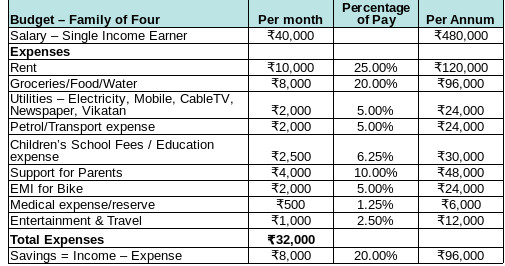
New year is here - while national budget is being prepared with a lot of vigor in the election year to impress voters, we have the responsibility to prepare a budget for our homes. Some of us may wonder if budgeting is of any use at all as most of our income anyway gets spent every month. This may be true in the initial income earning phase, when our incomes are lower but as we progress in our lives and career, annual planning of home budget greatly helps provide a disciplined approach to track our expenses in a structured manner. A Sample home budget Let us help Bharath, age 34, an administrative executive, prepare his annual home budget for 2019. He lives in a rented house with his wife and two children aged 5 & 3. His monthly take home pay is Rs.40,000 and he is a single income earner for his family. Bharath’s primary expense comprises his rent of Rs.10,000 and he spends another Rs.8,000 on food. His utilities and petrol/transport expenses comes to Rs.4,000....

Investment Triangle - Discipline & Time

Knowledge, Discipline & Time are the 3 vertices of an investment triangle. In this issue, we are going to examine the next 2 vertices of the investment triangle – Discipline & Time. Discipline is easy when imposed Discipline in investing is an essential ingredient to successful investing. When we stay invested in a right asset over a longer duration, it certainly pays off. Let us take Suresh, a teacher, who has a home loan EMI to pay for 15 years. Only if he pays his monthly EMIs regularly without fail, he could own the property at the end of the loan tenure. Paying a monthly EMI is a huge commitment and requires discipline on part of the investor. Similarly, take Sara, a lawyer, who pays the premium for her parent’s health insurance policy. Only if she pays the annual premium in a disciplined manner, her parents would be able to avail the hospitalization benefits. Most of us diligently pay our periodic payments in a disciplined way, like Suresh ...

Investment Triangle - Knowledge

Knowledge, Discipline & Time are the 3 vertices of an investment triangle. In this issue, we are going to examine the first area - Knowledge. Knowledge is foremost As investors, we need to be aware of the various financial products available in the market. Without first hand knowledge of various products, it is easy to fall prey to quick sales tricks and part our money to unsuitable products. Let us take the case of Anand, a manager in a private sector firm. In 2017, when he received his bonus, his relationship manager called him and recommended him to invest in Arbitrage funds (AF). The primary reason cited to him being good returns and no long term tax since arbitrage fund is treated at par with equity funds. It was further explained to him that a portion of the arbitrage funds would be invested in derivatives to cover any fall in stocks held by the fund. Anand was convinced and invested his entire bonus in one such arbitrage fund. However, Anand is very disappo...