Posts

Linking of PAN-Aadhar-Bank accounts
Image
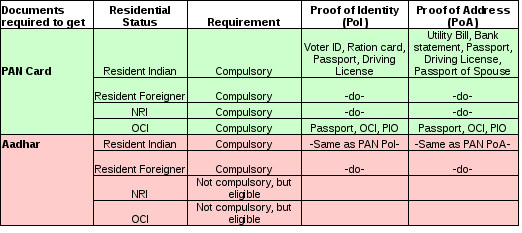
On Jun 9, 2017, the Supreme court in its ruling on IT section 139AA, upheld that all PAN card holders must link their Aadhar with their PAN (Permanent Account Number) for filing of income tax returns from July 1, 2017. And even non-IT assessees who have PAN & Aadhar as of July 1, 2017 must link the two on the IT portal. In another related notification, the government has mandated that all bank accounts in the country need to be linked to Aadhar by Dec 31, 2017, failing which the respective accounts will be frozen. Let us look into the details and impact of these announcements. PAN & its use PAN (Permanent Account Number) is a 10-digit unique ID issued by the income tax department, however a person may have multiple PANs. It is primarily used to file income tax returns and required for most financial transactions such as deposits & withdrawals exceeding Rs.50k, purchase of all assets such as car, bike, home, jewellery, mutual funds, demat accounts, bonds etc. Residents o...

Fixed or Floating rate for my home loan?

Image
With interest rates falling further and holding period for capital gains reduced from 3 to 2 years in the budget, new buyers and upgraders are looking to get the best realty deals. However, not all is done upon locating the property to buy. Choosing a right home loan product is vital to ensure that your hard earned money does not pay for exorbitant interest costs. Home Loan - Product A home loan comes with a variety of options and bargains but borrowers are not usually presented with all the available choices to make an informed choice. They are usually sold a product which may not suit them best. Let us take a case of a new buyer (or) an upgrader who seeks a loan of Rs.30 Lacs. This buyer is typically coerced into a 30-year "Fixed interest rate home loan" based on the lowest EMI option of Rs.23k per month. As this amount is close to the rental outgo of the buyer, s/he readily tends to accept the product. A "Fixed" interest rate is in favor of the borrower if ...

Did Demonetization really go after black money?

Image
Missing Tax Payers or Tax Evaders? Per the finance ministry, about 1.09 crore bank accounts received a deposit of Rs.2-80Lacs and another 1.58 Lac accounts received a deposit of >Rs.80Lacs. The IT department has officially said that after scrutinizing these 1.09 crore bank accounts, 18 Lac accounts whose deposits do not match their tax profile(s) are now under inquiry for tax evasion. What the demonetization reveals about Tax evasion? Post-demonetization, these 1.1 crore bank accounts received a total cash deposit of Rs.10.4Tn / $157bn. This number clearly matches the 1.05 crore missing assesses based on the top 1% wealthy. Demonetization has cleverly brought this huge chunk of people into the tax net. In the 1st category, only deposits over Rs.5Lacs are being inquired, while all accounts under the next category are under inquiry - here a high average of Rs.3.31 crores in cash is a clear indication of tax evasion . The tax on the Rs.10.4Tn deposits @35.535...

Behind Tax numbers..

Highlights of 2017 budget on Personal Taxation Reduce the tax rate of the lowest income slab (Rs.2.5-5Lac) from 10% to 5% IT rebate reduced from Rs.5k to Rs.2.5k & applies only for Income upto Rs.3.5Lacs Levy a 10% surcharge on those earning Rs.50L - 1Crore income Reduce the holding period from 3 to 2 years for real estate assets to qualify as long term Revealed the amount gathered under the demonetization scheme (Rs.10.4Tn) Direct Tax collection Based on the latest data published by the Income Tax (IT) department for AY2014-15, 3.91 crore returns were filed and a total of Rs.4.46Lac Cr (Rs.4.46Tn) in direct taxes collected. Key stats: Total returns filed: 3.91 crores Returns from Individuals: 3.65 crores (93%) Total tax paid by Individuals: Rs.1.91 Lac crore / Rs.1.91Trillion / $29bn 26 Lac returns filed by companies & firms Total tax paid by Companies: Rs.2.55 Lac crore / Rs.2.55Trillion / $39 bn The top 1.5% Tax payers The stats revealed that 47.5% (...

Demonetization - Impact on investments & returns!

With the dust settling down on the demonetization of Rs.500 and Rs.1000 notes (w.e.f 08-Nov-2016), the next question on everyone's mind is, "Does it affect my returns?". This blog explores demonetization's effect for savers who are also largely tax payers. Financial market With over Rs.8.45Trillion deposited into the banks as of 27-Nov, the system is flush with liquidity. A portion of this money is expected to be loaned out for businesses and individuals to start the investment and demand cycle. However in the immediate next 2 quarters, demonetization will keep demand subdued. RBI is currently in a rate cut cycle with further cuts in the offing. This is causing bonds to be the favorite investment pick among analysts (as bond prices rise when rates fall). However, the rate cut cycle is not a given - the quantum of rate cut is primarily dependent on inflation. Although domestic factors impacting inflation are benign with structural changes in supply side and a goo...

All about NPS

NPS is the much talked about National Pension Scheme introduced in 2004, for government employees. It is now open to all Indian citizens as a retirement saving vehicle. This blog explores the instrument and provides insight into the working of NPS. The account details NPS has a Tier-1 account, which is the non-withdrawable retirement savings account and a Tier-II account, a mere savings account. You can open an NPS a/c online using Aadhar or PAN card. The minimum contribution is Rs.500 pm / Rs.6k pa. Every subscriber gets a PRAN# (Permanent Retirement Account Number). NPS has 3 classes of assets: E: Investments in predominantly equity market instruments. Maximum investment in this class is 50% of total contribution. C: Investments in fixed income instruments other than Government securities. G: investments in Government securities. Investment Choices NPS offers "Active Choice" & "Auto Choice" options to its subscribers. Under the Active choice, th...

The Story behind Farm Subsidies

There is significant pressure on developing countries to withdraw their farm subsidies. Major developing economies such as India, China & Indonesia have strongly opposed the US & EU and warned them against withdrawal of farm subsidies, as they have billions of mouths to feed. This blog examines the issue and the points of contention! The Contention India's Food Security Act requires its government to feed the poor. India has a well established PDS (ration shop) system through which it distributes basic food grains and kerosene to its poor. The government buys food from farmers at a pre-determined price called MSP (Minimum Support Price), stocks them in its godowns and distributes it through the 5 lac ration shops across the country. For example, the MSP for rice may be Rs.32/kg, but at PDS it is sold to the poor at Rs.5/kg. The difference of Rs.27/kg is borne by the government, which works out to an annual expense of $20bn. According to the west, the difference between ...